Vishal Sharma
On this page
- What is CISA’s KEV catalog, in plain words?
- Which of these flaws matter to a 10-50 person office?
- Step 1: find out what’s actually in your office
- Step 2: check the firmware version
- Step 3: patch, replace or isolate?
- Step 4: check for signs of compromise
- Why end-of-life boxes are the real risk
- Sources
- Frequently asked questions
Between November 9 and 17, 2026, the U.S. Cybersecurity and Infrastructure Security Agency (CISA) added 13 flaws to its list of vulnerabilities that attackers are already using. The two a small office is most likely to own are the Barracuda Email Security Gateway (CVE-2026-116606 and CVE-2026-111560, chained to get root) and Check Point Gaia firewalls (CVE-2026-123039, used in attacks that ended with a data wiper). If you have either box, check the firmware version today. Barracuda’s fix is a patch most appliances get automatically. Check Point’s is the November Jumbo Hotfix. And if your box is too old to get the fix at all, that’s your real problem, and patching isn’t an option.
The rest of the list covers phone platforms, file transfer servers and admin tools. Most of those live at your phone provider or a bigger company, not in your server closet. The table further down sorts out which is which.
What is CISA’s KEV catalog, in plain words?
KEV stands for Known Exploited Vulnerabilities. It’s CISA’s running list of security holes that criminals are using right now, not just ones that exist on paper.
To get on the list, a flaw needs three things, according to CISA:
- A CVE number (the public ID, like CVE-2026-123039).
- Reliable evidence of real exploitation. Someone ran code on a system that wasn’t theirs. Scanning, lab research or a proof-of-concept doesn’t count.
- Clear remediation guidance, usually a vendor update, or removing an end-of-life product that can’t be updated.
U.S. federal agencies must fix KEV entries by a deadline. Nobody in Canada is bound by it. We still treat it as the best free “fix this first” list there is. A flaw with a scary score but no attacks can wait for your normal patch window. A KEV entry on an internet-facing box can’t.
Which of these flaws matter to a 10-50 person office?
Here’s every entry CISA added from November 9 to 17, sorted by how likely a small office is to own the product. We checked each against CISA’s alerts and the vendor’s own advisory.
| Product (CVE) | What it is | Will a small office have it? | What to do |
|---|---|---|---|
| Barracuda Email Security Gateway (CVE-2026-116606, CVE-2026-111560) | Spam and virus filter box that sits in front of your mail server | Yes, common in offices that bought one 5-10 years ago | Confirm patch BNSF-40425 or BNSF-40430 is applied. Lock the admin page to your internal network. Check for compromise. |
| Barracuda WAF, Load Balancer ADC, Web Security Gateway, Message Archiver, WAF Control Center (CVE-2026-111560) | Web filter, email archive, website protection | Sometimes (Message Archiver and Web Security Gateway most often) | Update to the latest firmware. This flaw needs admin access, so also check who can reach the admin page. |
| Check Point Gaia firewalls (CVE-2026-123039) | Firewall and VPN gateway (Quantum, Quantum Force) | Sometimes. Quantum Spark small-business models are not affected | Install the November Jumbo Hotfix take for your version. Check for compromise. Plan replacement if on R81.10 or older. |
| SignalWire FreeSWITCH (CVE-2026-116779) | Open-source phone switch inside some self-hosted phone systems | Rare, only if you run your own VoIP server | Update to 1.11.3. Ask your phone vendor if you’re not sure what’s under the hood. |
| OpenSSH (CVE-2026-123158) | Remote login service on Linux | Rare for the exploited setup (Alpine Linux and other musl-based builds without PAM) | Ask whoever manages your Linux boxes. Fixed in OpenSSH 10.6p2. |
| Cisco BroadWorks (CVE-2026-20320) | Platform phone carriers use to run hosted business phone service | No, your provider owns it | Ask your VoIP provider if they’ve installed release RI.2026.07. |
| Openwave Webtop Media Transcoder (CVE-2026-111793) | Carrier and ISP email platform component | No | Nothing for you to install. |
| IBM Aspera Faspex, Perforce Puppet Enterprise, GPUStack, UnrealIRCd | Large-file transfer, server automation, AI model hosting, chat server | Very unlikely | Ignore unless your IT provider runs one for you. |
The same CISA batch on November 10 also included an exploited Outlook flaw and a Chrome flaw. Those are on your PCs, not your network edge. Our post on the November Outlook zero-day and Patch Tuesday covers both.
Step 1: find out what’s actually in your office
Most owners we talk to know they have “a firewall” but not the brand. That’s fine. Here’s the 20-minute version.
- Look at the boxes. Go to the network rack or closet. Write down the brand and model printed on each device that isn’t a plain switch. Barracuda units are usually labelled on the front. Check Point boxes show the model number (e.g. 3600, 6200) on the front panel.
- Check your invoices and renewals. Search your email for “Barracuda”, “Check Point”, “subscription renewal” and “Energize”. (Barracuda calls its update subscription Energize Updates.) A yearly renewal tells you what you own and when you bought it.
- Check your email’s mail flow. If you use Microsoft 365, your admin can look at the domain’s MX record. If it points to a Barracuda address or your own office IP instead of Microsoft, something sits in front of your email.
- Ask your phone provider one question. “Is our phone system hosted on Cisco BroadWorks, and have you applied the November fixes?” A good provider answers in a day.
- Write it down. Brand, model, location, who has the admin password, and the support end date. This list is your starting point for every future alert.
If you don’t have an inventory at all, start one now. You can’t patch a box you don’t know about. Our office IT setup service builds one as part of any setup.
Step 2: check the firmware version
Barracuda Email Security Gateway
Sign in to the appliance’s web interface. The firmware version shows on the status dashboard and on the firmware update page. Then compare it with Barracuda’s advisory, published November 2:
- ESG on firmware 9.4.017 or later needs patch BNSF-40425.
- ESG older than 9.4.017 needs patch BNSF-40430.
- Security researchers, including Beazley Security, list 9.4.0.030 as the fixed ESG version. Barracuda’s own pages don’t spell out that number, so if you’re unsure, email support@barracuda.com and ask them to confirm the patch is on your unit.
Barracuda says patches are normally applied automatically. It also says: if a patch hasn’t been applied automatically, apply it manually as soon as possible. If someone turned off automatic updates years ago to “avoid surprises,” turn them back on.
Check Point Gaia
The Gaia Portal shows the version (R81.20, R82 and so on) on its Overview page. The installed Jumbo Hotfix “take” number is what matters. Your IT provider can confirm it from the command line. Check Point’s advisory sk1000362 lists the first fixed takes:
| Gaia version | Fixed Jumbo Hotfix take |
|---|---|
| R82.20 | Take 14 or later |
| R82.10 | Take 52 or later |
| R82 | Take 132 or later |
| R81.20 | Take 174 or later |
| R81.10, R81 | No fix. End of support |
Check Point says its Spark firewalls and Smart-1 Cloud are not affected. Spark is the line most small businesses buy, so many offices can stop here.
Step 3: patch, replace or isolate?
Make one decision per box. Here’s how we’d decide.
Patch it if the vendor still supports the model and a fix exists for your version. Do it this week. Schedule 30 minutes after hours, take a config backup first, and confirm the new version afterwards.
Isolate it if you can’t patch tonight. Both vendors’ interim advice comes down to cutting off access:
- Barracuda: restrict the admin interface to trusted internal networks. Barracuda says CVE-2026-116606 needs no password, but it does need the attacker to reach the admin page. If your ESG admin page answers from the internet, that’s the first thing to close.
- Check Point: sk1000362 gives a workaround that stops the
dynamic_serverprocess. It breaks some Dynamic CLI commands, so it’s a stopgap for your IT provider to apply, not a fix. - For the Check Point attacks, the way in was the Mobile Access portal (remote access through a web page). If nobody uses it, turn that feature off.
Replace it if any of these apply:
- The model is end of support, like Gaia R81.10 and R81 above. No fix is coming.
- You find signs of compromise on the device (see the next step).
- The update subscription lapsed and the vendor won’t sell you a renewal.
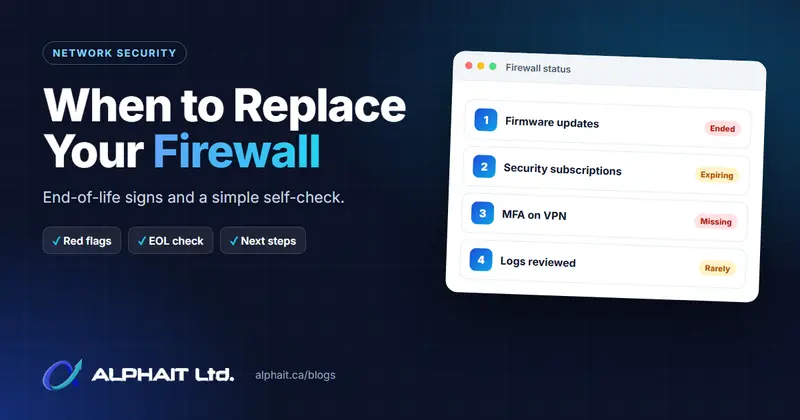
Replacing a firewall or email gateway in a small office usually runs to a few hours of work plus hardware, and it’s planned work. Cleaning up after a wiper isn’t. Our guide on when to replace a firewall walks through the end-of-life checks for Fortinet, SonicWall, Meraki and WatchGuard too.
Step 4: check for signs of compromise
Patching closes the door. It doesn’t evict anyone already inside. CISA’s own alerts now stress checking whether a system was breached before it was patched.
Barracuda ESG
Barracuda has confirmed exploitation affecting “a small number of organizations” but hasn’t published indicators. What researchers suggest checking:
- Unexpected changes to the global configuration, or a configuration backup restored that nobody on your side ran. (CVE-2026-116606 works by importing a crafted backup.)
- The timezone setting containing odd characters like
;,|or$(. That’s the field CVE-2026-111560 abuses. - Admin logins from IP addresses you don’t recognize.
If anything looks off, don’t just patch and move on. In 2023, after a different ESG flaw, Barracuda told customers that compromised ESG appliances “must be immediately replaced regardless of patch version level.” We’d apply the same rule today. A box that’s been rooted can’t be trusted again.
Check Point Gaia
Check Point Research published a detailed report on November 12. The chain started with the PHP2Shell flaws (CVE-2026-109618 and CVE-2026-109619), the same PHP bugs we covered in our October PHP vulnerabilities post. Attackers hit unpatched Mobile Access portals, used CVE-2026-123039 to get root, installed a backdoor, then moved to VMware ESXi hosts and ran a wiper. Things your IT provider should look for:
- Files named
zz*.tplorchallenge_render.tplin the portal templates folder, and/tmp/.up.tpl. /lib/libcpfwcommon.so,/tmp/CPconfigdaemonor/tmp/.p_sockon the gateway.- Anything listening on TCP port 11072.
- SSH sessions from the firewall to your ESXi or other servers, especially as
vpxuser. A firewall has no reason to log in to your servers. - In
/var/log/dynamicCli.log, commands likewhoami,curl,wgetoruseraddthat nobody on your side ran. - A spike of crashes (segfaults) in the portal’s web processes.
One trap: the backdoor can survive in backups and Gaia snapshots. Don’t “fix” a suspect gateway by restoring a snapshot taken after October 30. Restore from older known-good config, or rebuild.
If you find any of this, treat it as an incident. Call your cyber insurer before you wipe anything. They often want the evidence kept.
Why end-of-life boxes are the real risk
Look at the pattern. Every fix above depends on the vendor still supporting your model. Check Point lists R81.10 and R81 as affected, with no fix. CISA’s own KEV criteria count “removing an end-of-life product” as a valid fix.
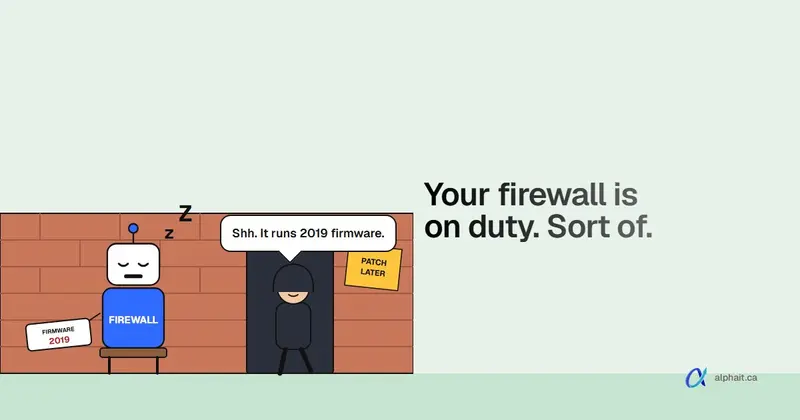
Firewalls and email gateways are the boxes nobody touches once they work. They sit in a closet for eight years, quietly running out of support. Then a flaw like this arrives and the only answer is a rushed purchase.
If you only do one thing this week, find the support end date for your firewall and your email gateway. Put both in your calendar a year ahead. That turns an emergency into a budget line.
Also ask whether you still need the box. Many offices bought an email gateway when they ran their own Exchange server. If you’ve since moved to Microsoft 365, the gateway might be doing work Microsoft’s filtering already does. Our email security page covers what a modern setup looks like.
Sources
- CISA: Known Exploited Vulnerabilities catalog (criteria and who must follow it)
- CISA: Adds Four KEVs, November 9, 2026 (GPUStack, FreeSWITCH, OpenSSH, IBM Aspera Faspex)
- CISA: Adds Six KEVs, November 10, 2026 (Cisco BroadWorks, Barracuda x2, Openwave, Outlook, Chromium)
- CISA: Adds Two KEVs, November 13, 2026 (UnrealIRCd, Check Point)
- CISA: Adds One KEV, November 17, 2026 (Perforce Puppet Enterprise)
- Barracuda Trust Center: Pre-authentication authorization bypass and command injection (affected products, patch IDs, exploitation update Nov 9)
- Barracuda Campus: Security updates available for certain Barracuda products
- Barracuda Trust Center: 2023 ESG vulnerability (replace compromised appliances)
- Beazley Security Labs: BSL-A1240 Barracuda ESG advisory (fixed versions per product, compromise checks)
- Check Point: sk1000362, CVE-2026-123039 (affected versions, Jumbo Hotfix takes, workaround, log checks)
- Check Point Research: PHP2Shell exploitation on Check Point gateway (attack chain and indicators)
- Cisco: BroadWorks XML external entity vulnerability, cisco-sa-bworks-xxe-uwUd7CEt
- Canadian Centre for Cyber Security: Check Point advisory AV26-1154
- Canadian Centre for Cyber Security: Barracuda advisory AV26-1112
- Help Net Security: OpenSSH “SSHole” CVE-2026-123158 exploited
Frequently asked questions
What does it mean when CISA adds a flaw to the KEV catalog?
It means CISA has reliable evidence that attackers are using that flaw against real systems, and that a fix or mitigation exists. U.S. federal agencies must patch by a deadline. Canadian businesses aren’t bound by it, but it’s a solid list of what to fix first.
Is my Check Point small-business firewall affected by CVE-2026-123039?
Check Point says its Spark firewalls, the Quantum Spark line sold to small businesses, are not affected, and neither is Smart-1 Cloud. The flaw affects Gaia OS versions R81 through R82.20 on larger gateways. R81.10 and R81 are end of support and have no fix.
Does my Barracuda email gateway update itself?
Usually. Barracuda says patches are normally applied automatically, but tells customers to apply them manually if they weren’t, and to turn automatic patching back on if it was disabled. Check the firmware version yourself, or ask Barracuda Support to confirm.
We use a hosted phone system. Do we need to do anything about Cisco BroadWorks?
Not on your end. BroadWorks runs at the phone carrier or VoIP provider. Ask your provider whether their BroadWorks servers are on release RI.2026.07 or later. Cisco’s advisory says there’s no workaround, only the upgrade.
Is patching enough if our device was already exposed?
No. Patching stops new break-ins but doesn’t remove a backdoor already installed. Check the device for the signs each vendor lists. If you find any, replace or rebuild it from known-good config rather than restoring a recent backup.
Not sure what’s sitting in your network closet or whether it’s still supported? AlphaIT’s firewall and network security team can check versions, apply fixes and plan replacements. Contact us.