Vishal Sharma

On this page
- What prosecutors say happened
- Is this a Canadian problem too?
- What do these calls and video meetings sound like?
- Rule 1: hang up and call back on a number you already have
- Rule 2: pick an office code word
- Rule 3: two people for new payees and banking changes
- A written payment-change procedure you can copy
- How this plays out by type of office
- Money already sent? The first hour
- Where tech helps, and where it doesn’t
- Sources
- Frequently asked questions
Your boss’s voice on the phone is no longer proof that your boss is on the phone. Federal prosecutors in Manhattan unsealed an indictment on Thursday, November 5, 2026 against Jacob Soall (41), Sharon Hazan (54) and Guy Sheetrit (42). They say the three used AI-generated voices, and sometimes faces, of real CEOs and lawyers to talk company staff into wiring about US$129 million. The charges include wire fraud, aggravated identity theft and money laundering. They’re allegations, and all three are presumed innocent. The defence that works is boring and free: no money moves on a call alone. Every urgent payment request gets a call back on a number you already have, a code word, and a second person’s approval.
Below: what these calls look like, the rules I’d set, a procedure to copy, and the first hour if money already left.
What prosecutors say happened
Here’s the alleged playbook, as reported by the Associated Press and Ynetnews from the charging documents and the U.S. Attorney’s Office for the Southern District of New York.
| Step | What the group allegedly did |
|---|---|
| 1. The hook | An email that looks like it’s from the company’s CEO. It asks for help with a confidential transaction, often aimed at the accounting team. |
| 2. The call | A phone or video call where AI imitates the CEO’s voice and, in some cases, face. |
| 3. The handoff | Staff are told to contact an “attorney” at a big law firm. That lawyer is also fake. Soall allegedly posed as UK lawyers, working from a handwritten script titled “Lawyer Call.” |
| 4. The wire | The fake lawyer tells staff to wire large sums to bank accounts around the world. |
| 5. The cash-out | Prosecutors say the money was converted to cryptocurrency and split up. |
Reported victims include a Missouri hospital system (about $4.83 million), a California hospital system (nearly $3 million) and a UK fintech company ($11.58 million). One New York investment firm stopped a $2.85 million transfer at the last moment. Ynetnews reports the three were arrested in Spain and the UK between June and September 2026, and extradition requests are pending.
One correction to the way this story has been shared. It’s often described as “payment redirection,” where a supplier’s bank details get swapped. That’s not quite what’s alleged. This was CEO fraud: a fake boss invents a secret deal, then hands you to a fake lawyer who gives the wiring instructions. Nobody hacked a bank. The victims’ own staff sent the money. That’s why the fix is a process, not a product.
Is this a Canadian problem too?
Yes. In June 2025, the Canadian Anti-Fraud Centre (CAFC) and the Canadian Centre for Cyber Security issued a joint advisory about texts and AI voice messages impersonating senior officials. They said a campaign was targeting business executives and senior public officials. In July 2026, the Cyber Centre’s vishing guidance warned that attackers use AI and short audio samples to clone the voice of someone you trust.
The CAFC counts CEO fraud under spear phishing. Canadians reported about $57.7 million in spear phishing losses in the first six months of 2026. All of 2025 topped $68 million. The CAFC also estimates only 5% to 10% of fraud is reported. It doesn’t publish a separate figure for deepfake calls, so treat any “Canadian deepfake losses” number you see online with suspicion.
A small Edmonton office is not too small for this. Your owner’s voice is on your website video, a podcast, a voicemail greeting or an Instagram reel. A few seconds can be enough.
What do these calls and video meetings sound like?
Forget the obvious robot voice. A good clone sounds like your boss on a bad line. What gives it away is usually the situation, not the audio. Watch for:
- Secrecy. “Keep this between us.” “Don’t loop in the partners yet.” “You’ll need to sign an NDA.” Real deals have more people in them, not fewer.
- A handoff to someone you’ve never dealt with. “Our lawyer in London will call you with the details.” The fake boss starts it. The fake lawyer finishes it.
- Urgency tied to a deadline you can’t check. “It has to close before 3 p.m. their time.”
- A new channel. The boss who never texts suddenly wants WhatsApp, or a video link from an unfamiliar address.
- Short, controlled video. Camera “glitching,” a frozen frame, a quick drop-off when you ask a question, or a meeting where only the boss talks.
- Odd audio. The Cyber Centre flags unusual delays, robotic voices or distorted audio. The joint advisory adds flat tone and odd background noise.
- Pushback on checks. “I don’t have time for that.” A real boss will wait two minutes for a call back.
None of these alone proves fraud. Any one of them, plus a money request, means you stop and verify.
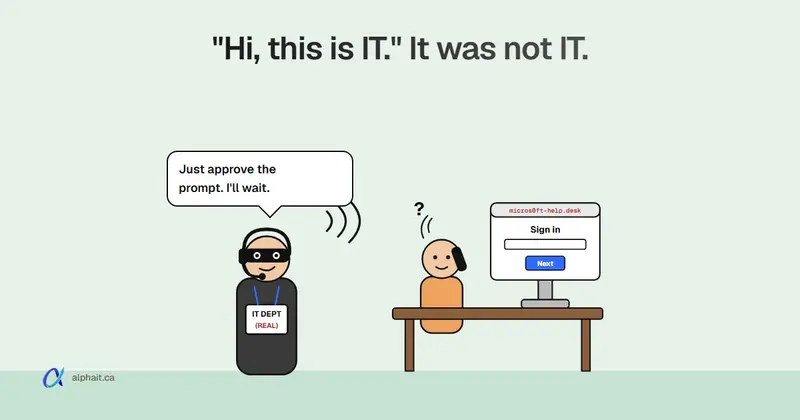
Your team gets fake help desk calls too, which work the other way round: someone “from IT” wants remote access, not money. We covered that in the fake IT help desk call scam. The rules below handle the money side.
Rule 1: hang up and call back on a number you already have
This is the rule that would have broken every step of the alleged scheme. The Cyber Centre’s advice is direct: “Hang up and call back using a known, trusted number.” It adds: don’t use numbers provided by the caller or your phone’s callback option.
What “a number you already have” means in practice:
- For your boss or a partner: their mobile from your staff list or phone contacts, saved before today.
- For a lawyer or law firm: the firm’s main switchboard from its official website, typed in by hand. Ask reception for the lawyer by name. Never use the number in the email signature or the meeting invite.
- For a supplier: the number in your vendor file. Changing a supplier’s bank details is its own scam with its own checks. Our fake invoice guide walks through that call-back step by step.
Caller ID proves nothing. It can be spoofed. A Teams or Zoom meeting proves nothing either. If the boss’s Microsoft 365 account was taken over (see how attackers get past MFA by stealing sessions), the invite comes from the real account.
Rule 2: pick an office code word
Families are being told to agree a secret word for “I’m in trouble, send money” calls. The FBI suggests it, and the Cyber Centre recommends “safe words or call-back codes.” It works just as well in an office.
How to set it up:
- The owner and whoever can release payments agree on a word or short phrase. Pick something that isn’t on social media: not a pet’s name, not the company’s founding year.
- Share it in person only. Never by email, text or Teams, because that’s where an attacker would look.
- Any urgent payment request by phone or video must include it. Ask for it; don’t hint at it.
- Change it when someone with access leaves, and at least once a year.
- The Cyber Centre’s rule applies: if the caller can’t pass the check, assume the call isn’t real. No exceptions for “I forgot, I’m boarding a plane.”
The code word is a backup, not a replacement for the call back. Do both.
Rule 3: two people for new payees and banking changes
One person should never be able to create a new payee and send money to it. Split it:
- Person A enters the new payee or the changed banking details.
- Person B does the call back and approves. Person B is never the person who got the request.
- For the owner’s own urgent requests, the second person is someone other than the owner. That feels awkward. Do it anyway. It protects the owner too.
Many business banking platforms offer dual approval for wires and new payees. Ask your bank whether yours does, and turn it on. In a two-person office, your bookkeeper or accountant can be the second approver.
The trade-off is speed. A real urgent wire might take 20 extra minutes. I’d take that every time over a $40,000 loss.
A written payment-change procedure you can copy
Print this. Put it beside whoever pays the bills. Have the owner sign it so staff know they won’t get in trouble for slowing down a “boss.”
[Company name] payment verification procedure
- No payment, new payee or banking change is approved from an email, text, chat, phone call or video call alone. This applies to everyone, including the owner and partners.
- Any request to send money that is urgent, confidential, outside our normal process, or over $[amount] is verified by calling back the requester on a number already in our records. Never use a number, link or meeting invite from the request itself.
- Requests by phone or video must include the office code word. If the caller can’t give it, we end the call and verify as in step 2.
- Requests that hand us to a lawyer, accountant or adviser we don’t already know are verified by calling that firm’s main line from its official website.
- Every new payee or banking change needs two people: one to enter it, one to verify and approve. The approver is never the person who received the request.
- “Keep this confidential” and “don’t tell anyone” do not override this procedure. Staff are expected to tell the owner, a partner or our IT provider.
- Each verification is logged: date, time, who asked, who verified, the number called and the result.
- Staff who follow this procedure and delay a real payment will never be disciplined for it.
Signed: __________ (Owner) Date: __________
Point 8 matters most. Fraudsters count on people not wanting to annoy the boss. Take that fear off the table in writing.
Want to test how your team does under pressure? Run them through our free Spot the Scam quiz.
How this plays out by type of office
- Accounting firms: you move client money and know closings happen. A “client CEO” asking you to release funds for a deal is the exact script. Verify with the client through the contact on your engagement letter.
- Law firms: watch both directions. Fraudsters impersonate lawyers to others, and may impersonate your clients to you. Trust account withdrawals deserve the strictest version of Rule 3.
- Construction companies: owners are often on site and hard to reach, which makes “I’m on site, just send it” believable. Agree the code word before the busy season.
- Clinics: the reported US victims include two hospital systems. A clinic manager getting an urgent “doctor-owner” call about an equipment deposit fits the pattern. Our medical clinic IT support page covers the wider set-up.
Money already sent? The first hour
Speed decides whether any money comes back. Do these in order.
- Call your bank’s business fraud line right now. Not email, not the branch tomorrow. Ask them to stop or recall the wire and contact the receiving bank. Have the date, amount, receiving account and confirmation number ready. If the money went through a payment provider, call them too.
- Stop any second payment. These groups often come back for more. Tell everyone with payment access: nothing goes out until the owner says so in person.
- Save the evidence. Don’t delete the emails, texts, meeting invites, call logs or voicemails. Write down what was said, in order, while it’s fresh.
- Report to the Edmonton Police Service. Call the non-emergency line at 780-423-4567 (or #377 from a mobile). EPS asks you to have your documents ready and to write events down in order. Keep every file or occurrence number.
- Report to the Canadian Anti-Fraud Centre. Use the online reporting system or call 1-888-495-8501, Monday to Friday, 10 a.m. to 4:45 p.m. Eastern. The CAFC asks victims to contact local police as soon as possible as well.
- Call your IT provider. If a real mailbox was used, it needs securing today. Our fake invoice post has the mailbox clean-up steps.
- Tell your insurer. Crime or cyber policies often have notice deadlines.
The bank comes first because a recall only works while the money is still sitting in the receiving account. Police and CAFC reports matter, but they come second. (EPS’s own reporting page lists police, then CAFC, then the bank. For a wire that just left, phone the bank first.)
Where tech helps, and where it doesn’t
No filter can tell a cloned voice from a real one on your phone. The procedure above does the heavy lifting. Tech still helps around the edges. Good email security catches many of the first “confidential transaction” emails before they land. Strong sign-in protection keeps attackers out of the boss’s real mailbox, which makes the fake email far more convincing. It’s also worth asking how much of the owner’s voice and video you really need online.
Sources
- U.S. Attorney’s Office, Southern District of New York: Three Foreign Nationals Arrested And Charged With Scheme To Use Super Intelligence To Defraud Companies Of $129 Million (press release; the page blocked automated reading, so details were checked against the reports below)
- KTVU / Associated Press: 3 accused of using AI to impersonate CEOs in $129M fraud scheme (November 6, 2026: names, ages, charges, method, “Lawyer Call” script)
- Ynetnews: Fake CEOs, stolen millions: two Israelis charged in $129 million AI fraud scheme (victims and amounts, arrests, extradition)
- CAFC and Canadian Centre for Cyber Security: joint advisory on impersonation of public figures (June 23, 2025)
- Canadian Centre for Cyber Security: What is voice phishing (vishing)? ITSAP.00.102 (July 2026)
- Canadian Anti-Fraud Centre: Fraud trends, first six months of 2026
- Canadian Anti-Fraud Centre: Report fraud
- Edmonton Police Service: Reporting fraud
- FBI IC3: Criminals use generative AI to facilitate financial fraud (PSA241203) (December 3, 2024: secret word advice, real-time video calls with fake executives)
Frequently asked questions
What is a deepfake CEO scam?
It’s a fraud where criminals use AI to copy an executive’s voice or face on a phone or video call. They ask a staff member to send money urgently, often for a “confidential deal.” In the US case unsealed in November 2026, prosecutors say the fake CEO then handed staff to a fake lawyer, who gave the wiring instructions.
Can you tell a cloned voice from a real one?
Not reliably. Some clones have delays, a flat tone or odd background noise, but good ones sound like a normal call on a weak line. Don’t rely on your ear. Rely on the call back to a number you already have, plus an office code word.
Is a video call enough to confirm a payment request?
No. The FBI warns criminals create video for real-time chats with fake company executives. A meeting invite can also come from a real account that’s been taken over. Hang up and call the person back on a number already in your records.
Who do I report a deepfake payment scam to in Edmonton?
Call your bank first to try to recall the money. Then report to the Edmonton Police Service on the non-emergency line, 780-423-4567, and to the Canadian Anti-Fraud Centre at reportcyberandfraud.canada.ca or 1-888-495-8501.
How often should we change the office code word?
Change it whenever someone who knew it leaves, and at least once a year. Share it only in person, never by email or chat, so a hacked mailbox can’t reveal it.
Want help writing a payment procedure your team will actually follow, or turning on dual approval and stronger sign-in protection? AlphaIT’s cybersecurity team can set it up with you. Contact us.